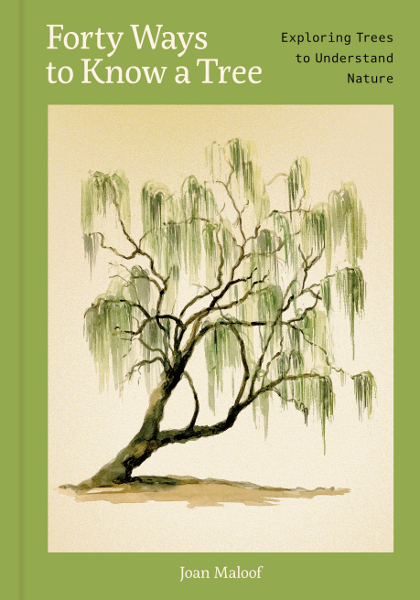
image courtesy Chronicle Books, all rights reserved
.
All content included on this site such as text, graphics and images is protected by U.S and international copyright law.
The compilation of all content on this site is the exclusive property of the site copyright holder.
Forty Ways to Know a Tree: Exploring Trees to Understand Nature, a book review
by Joan Maloof, illustrated by Sara Nunan
image courtesy Chronicle Books, all rights reserved
Wednesday, 8 April 2026
I live in a house surrounded by trees. Deciduous trees that drop their leaves in winter. There are oaks and sycamores, tulip trees and more. Relatively nearby there are public gardens with even more kinds of trees planted to delight their visitors, such as the great trees of the Morris Arboretum
Let us consider - What makes a tree? Trunk. Branches. Twigs. Leaves. Fruit. Roots.
It is a matter of learning to see what we are looking at. They provide artistic incentive
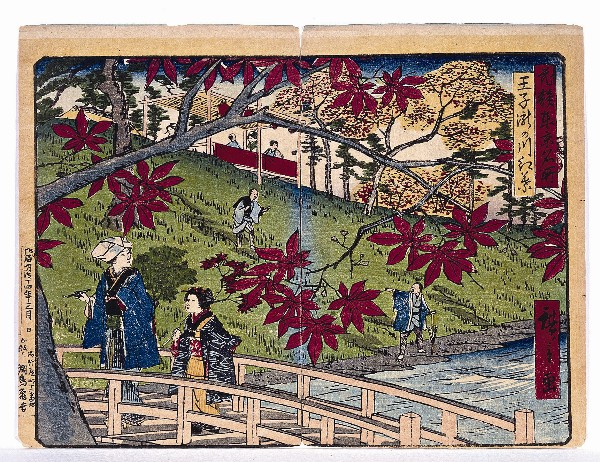
such as Utagawa Hiroshige III 1881 woodblock print of a Japanese maple from Kakyo Tokyo meisho.
Have you ever heard of shinrin-yoku, "forest bathing"? It involves slow, mindful walking or sitting in nature,
immersing oneself in nature using all your senses of sight, sound, taste, scent, and touch to improve well-being.
 .
.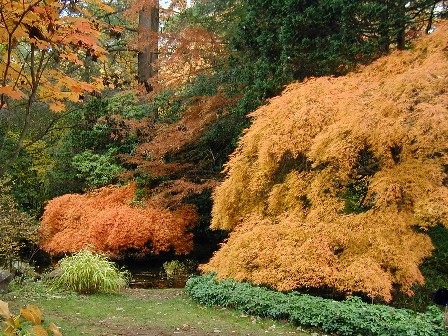
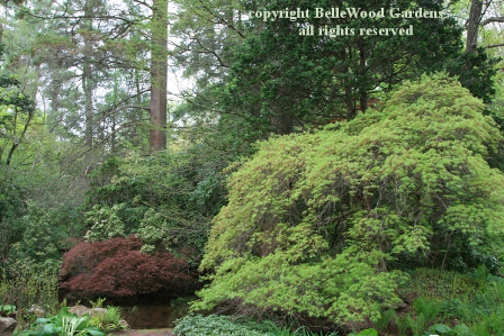
Return again, again, again and see how the year brings changes to Japanese maples between late April and early November.
.
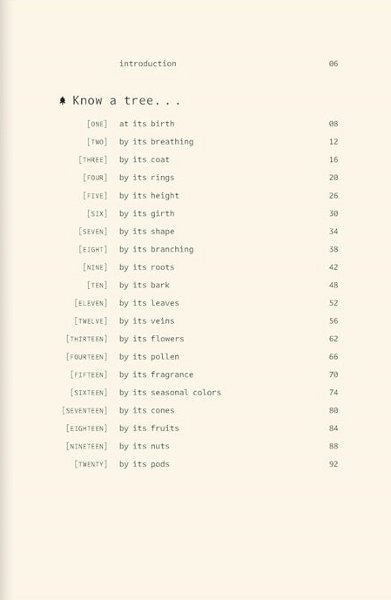
What might we find out if we could but learn to know a tree. What might details of their growth and life teach us.
 .
.
image courtesy Chronicle Books, all rights reserved
Pragmatic, that which the tree needs for it to live. Others are, let us say, are philosophical, that bring us to contemplation.
In the beginning . . . isn't that the way all good stories begin? So too the 400 year old oak tree
in front of the author as she begins this book that will take the reader on a journey of discovery.
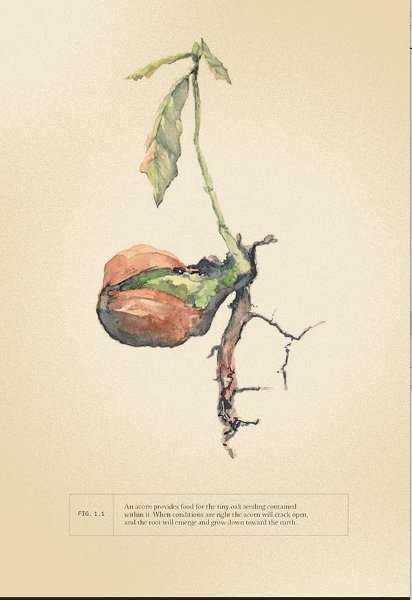
image courtesy Chronicle Books, all rights reserved
An acorn matures, drops to the ground, a root emerges.
It may be the place some tree will stand for centuries.
Maloof brings to our attention and weaves strands few of us consider: trees have no parents to help and guide them in the sense that we do. The forest has no one to tend it like a garden. The sprouting acorn is on its own.
An invitation to look more closely at a tree, to know it by its breathing.
Breathing? An opinion. Subjective vs objective.
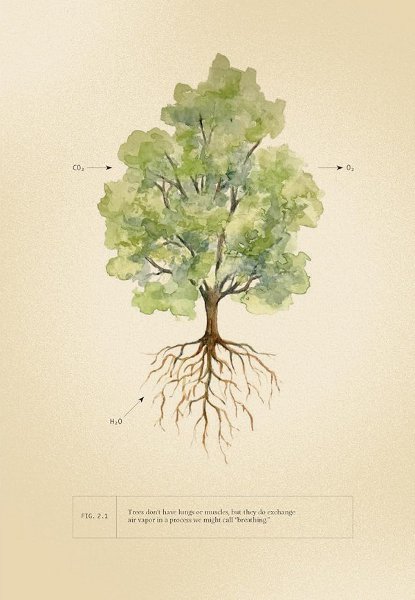
image courtesy Chronicle Books, all rights reserved
No lungs. No muscles. Yet they take in carbon dioxide and exhale oxygen.
And with increasing levels of carbon dioxide aren't we grateful that they do.
Discussion of leaves, needled evergreen or broad leaved deciduous. Cone bearing conifers. Animals making use of conifers for winter shelter. Deciduous broad leaf trees in temperate regions that change from green to red and then brown as they die and drop to the ground. Tropical broad leaved evergreens that provide animals with shade and protection from heat. Just think of all these possibilities and options, for a leaf.
It is not merely the charming watercolor illustrations that are so appealing. What also attracts me to the book is the very readable text. Concise. Pithy. Readable even for not botanical / horticultural cohorts of readers. Many of the sections will have a moment wherein the reader thinks to themselves, "Yes, I remember observing this and now I know what it means." One such aha! moment for me concerned know a tree by its rings. It was a paragraph about a venerable bristlecone pine "which had more than 4,500 rings." These pines grow at elevation where few woody plants can survive. In fact, bristlecone pines fail to thrive where conditions are more clement. On a North American rock garden society annual meeting in Colorado we were high in the Rocky Mountains, admiring these ancients of days. My husband found a fallen twig, barely the diameter of his little finger. And no matter how much effort he exerted it could not be broken.
You might not have considered the sections suggesting we might know a tree through its animals. True, this is foreshadowed by the mention, early on, of elk foraging for winter food under conifers whose branches protect the ground from snow, or tropical broad leaved evergreens offering welcome shade from hot sun. If asked for suggestions of who utilizes trees we might think of birds. Insects. More. Unique situations - did you think of Australian koalas that consume eucalyptus leaves?
A delightfully informative book that offers contemplative forest bathing first from reading and then learning to think more deeply about what you see when looking at a tree.
Forty Ways to Know a Tree: Exploring Trees to Understand Nature
by Joan Maloof, illustrated by Sara Nunan
Published by Princeton Architectural Press / Chronicle Books
Hardcover, 8.5 inches high by 5.3 inches wide, $25.95
ISBN 978-1-7972-3803-6, on sale April 7, 2026
A review copy of this book was provided by the publisher
If you have any comments or questions, you can e-mail me: jgglatt@gmail.com
Back to April
Back to the main Diary Page